Document Metadata
title • Newswink
whole number • 16
publication date • 28 May 1983
editor • Rick Tucker
proofread • 12 October 2026
NEWSWINK SIXTEEN
An official publication of the North American Tiddlywinks Association
28 May 1983
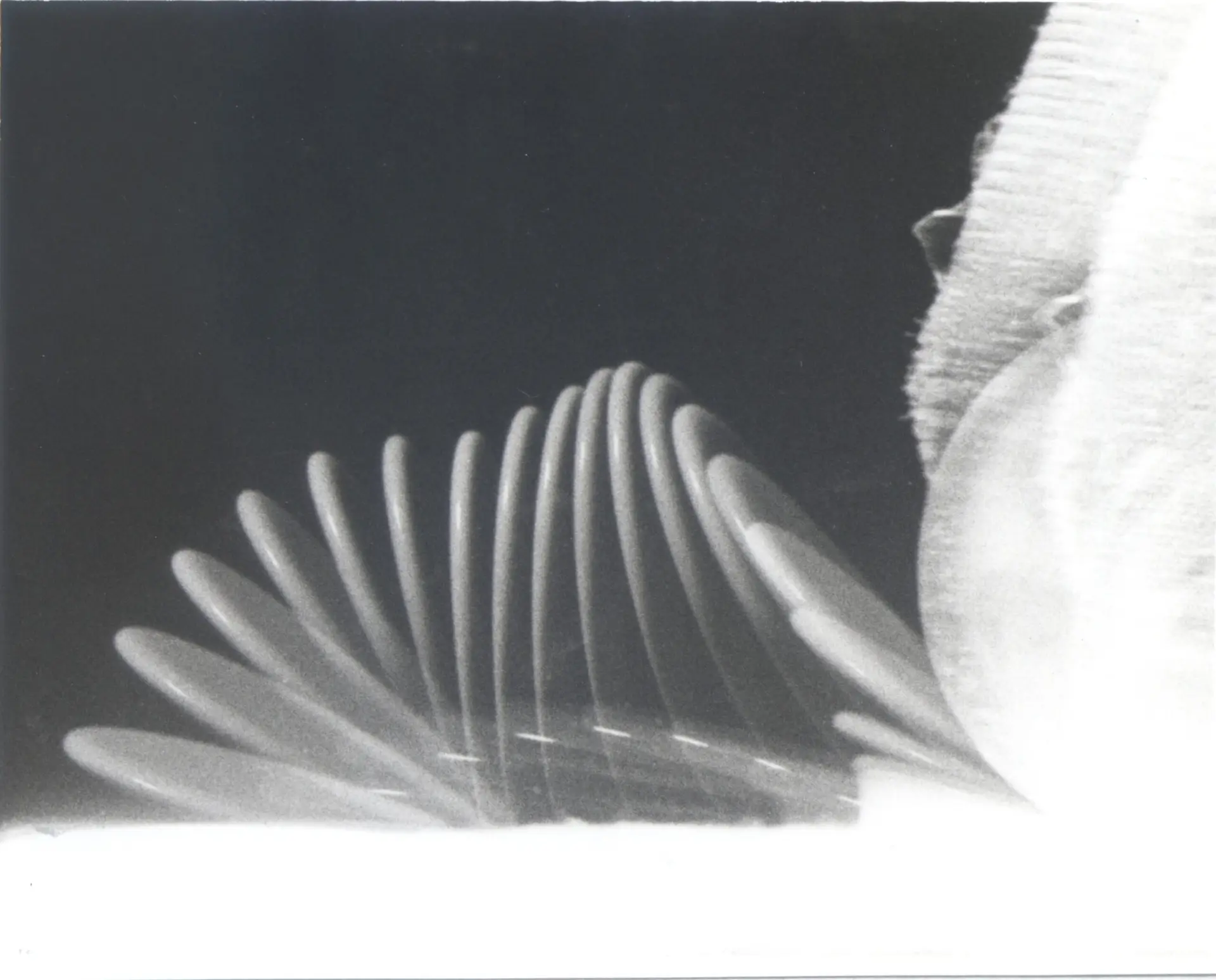
BRISTOL
120 flashes per second
© 1983 R. W. Tucker
World Singles
# 15 Larry Kahn, challenger, defeats Dave Lockwood, 29½ to 19½
# 16 Jon Mapley challenges Larry Kahn—Kahn Wins! 25 to 17
# 17 Dave Lockwood challenges the winner of # 16
Start of page 2
More thoughts on strategy, or is it tactics?
- Stance. Should you stand square to the line of flight, facing the pot, or sideways on, so that head is over a point say 10-12 inches along the line of flight? Should you crouch so that your eyes are near to the level of the mat?
- Grip. One hand or two? Thumb(s) or finger(s) on top?
- Style. Squopping or otherwise? Smooth, flip or smooth with a final jerk?
- Size of squidger.
- Flexible or rigid squidger?
- Winks concave up or convex up?
- Order of play.
- The two-handed squopping style with a large slightly flexible squidger works reasonably well with small winks played convex-up over a distance not exceeding two feet six inches. Using this style for longer shots and for large winks I find the winks are too likely to roll. This style minimises spin, which I think is a desirable thing.
- For direction, I prefer to stand immediately behind the wink, facing the point I’m aiming at, feet slightly apart, knees straight.
- I use a small thick squidger, and get the thumb right in the centre of it, on top, and use a smooth action with a slight stop before the moment of release. This seems to impart a braking effect. Too much flip gains too much height, therefore bounce, therefore lack of control.
[Start of page 3]
King Kahn
by Dave Lockwood
After 4½ years, 62 games, and 10 matches, the reign of Dave “The Dragon” Lockwood as World Singles champion has come to an end. The King is dead! Long live the King! … or the Horsemeat in this case. As might have been expected, the only person who could topple Dave was Larry “Horsemeat” Kahn, long regarded as the world’s best shooter. Larry’s long struggle to gain the top spot in world winks has finally been completed.
Larry’s quest really began at the NATwA Singles in 1978. Larry was 9-0 for 56 going into the final preliminary game… against Dave. Dave succeeded in a brilliant potout (the first trom 2 feet, the last from about 11 inches and took a 6-1 victory. This left them tie at 57 points each at the end of the preliminaries. Larry’s 7-0 loss to Severin Drix and a 6-1 loss to Bob Henninge clinched victory for Dave with a round left. Dave beat Larry 4½-2½ in the final game to permit a hard-charging Bob (47 points in the prelims) to bump Larry into third. Dave’s successful defense of the NATwA Singles gave him a second shot (in August 1978) at the World Singles held by Severin. Dave won by a score of 25½-23½ to take the title and begin his record-setting reign.
Larry’s slump continued through the next season (1978-79) as Joe Sachs and Severin dominated the NACs (North American Championships). Larry finished fourth in the 1979 Singles behind Severin, Joe, and Dave.
Since then, “Mr. Meat” has dominated NATwA… but not IFTwA.
1980.
- Teams – 3rd (Moosewinks, with Severin, Dave, Rich Steidle, and the Barbanos)
- Pairs – won (with Arye Gittelman)
- Singles – 2nd to Pam Knowles (UK) to earn World Singles challenge as top American
- World Singles 10 (Aug) – loses 30-19 after leading 16-12. Rated best match
1981.
- Teams – 2nd (Alliance, with Dave, Joe, Martin Ross, Paul Mailman
Rick Tucker, Fred Shapiro) - Pairs – won (with Severin)
- Singles – won
- World Singles 13 (Nov) – lost 27½-21½. Third closest match.
- Teams – 2nd (Alliance, with Dave, Joe, Rick, Fred, Rich)
- Singles – won with record unbeaten score.
- Pairs – 3rd (with Rick)
- World Singles 15 (Feb) – won 29½-19½. Finished with a blazing 7-0.
- Teams – won (Alliance, with Dave, Joe, Rick, Fred)
Upcoming Winking Dates
- 26 May/World Singles 16 at MIT — Jon Mapley vs. Larry Kahn
- 27 May/World Singles 17 — Dave Lockwood vs. winner of WS16
- 28-29 May/North American Singles at MIT
- 24 June/World Pairs — Charles Frankston and Joe Sachs vs. Larry Kahn and Severin Drix
- 25-26 June/North American Pairs at Ithaca
start of page 4
Villager is world champion in tiddlywinks
The Gazette, Montgomery County, Maryland, 16 March 1983, page B-16, in the column Montgomery County News by Joyce Kim. 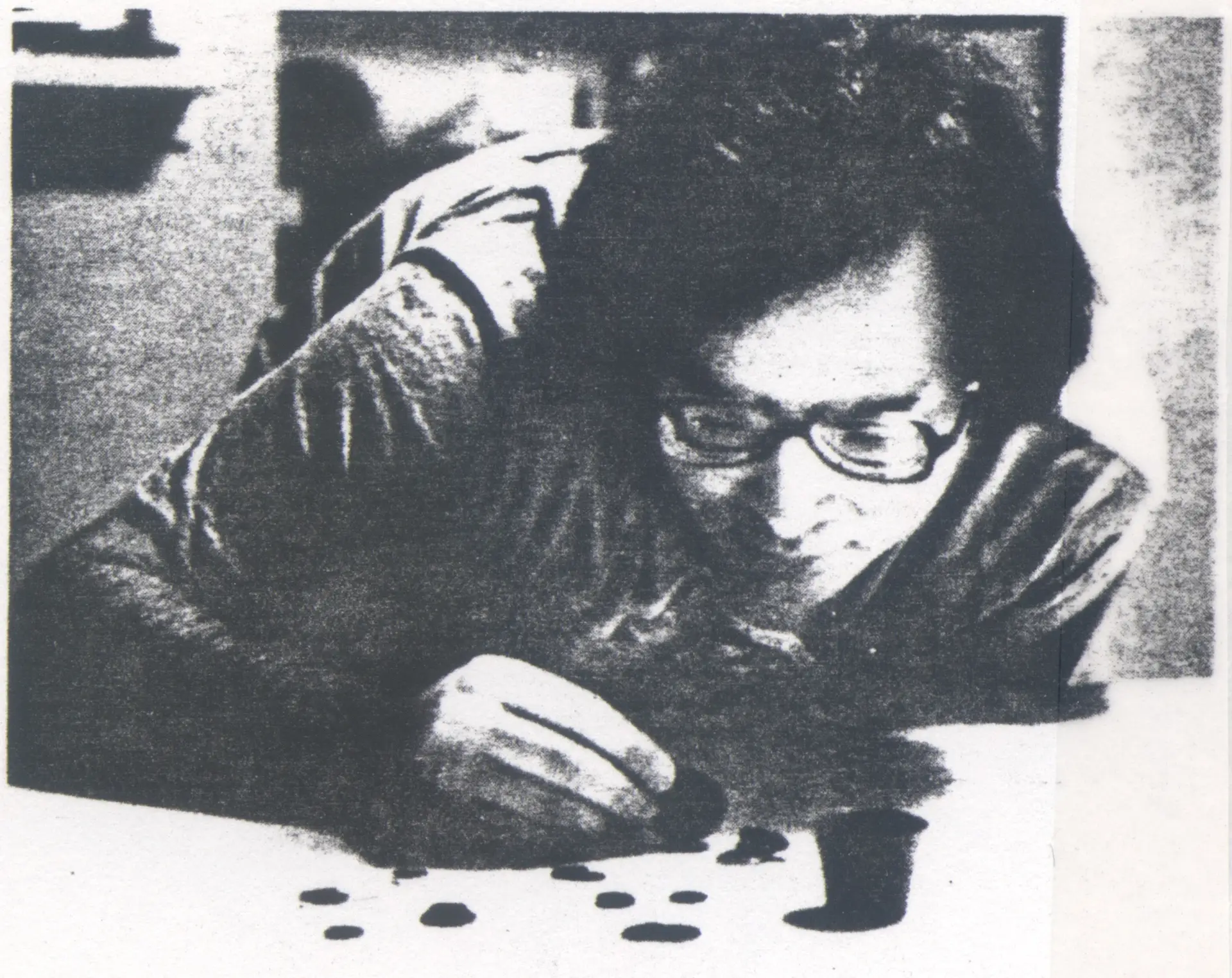
TIDDLYWINKER LARRY KAHN of Montgomery Village can squop a wink, as he is doing above, better than anyone else. The official singles Tiddlywink champion of the world, he hopes to attract other players to this sport.
—Photo by Joyce Kim
Nobody can “squop” a wink like Larry Kahn can. He is, in fact, the tiddlywinks champion of the world.
Tiddlywinks is no longer the children’s game of flipping discs into a cup (“‘potting”) that it used to be. Cambridge and Oxford University students in England, during the mid-fifties, developed the game into one of skill and strategy. They added the concept of “squopping”—shooting one’s discs onto opponent’s winks so as to immobilize them.
The new, improved tiddlywinks was brought to America by an Oxford team which defeated everybody but taught others how to play the game.
Harvard University fielded a good team in the early sixties, but the game nearly faded out of existence until players at Massachusetts Institute of Technology (MIT) and Cornell University built the game back up in the late sixties.
Cambridge, Boston, and Ithaca, N.Y., remain the hotbeds of American tiddlywinkism, though the game has spread to both coasts by alumni of these schools who did not want to stop “winking” after college.
Larry Kahn, originally from Miami, and a 1975 graduate of MIT, is the unquestioned singles tiddlywinks champion of the world. He won the two most recent pairs tournaments held in England and he came away the singles victor at last month’s “Continentals” at MIT.
Now a naval computer engineer for EG&G Inc., Larry lives in Nathan’s Hill in Montgomery Village. He has two other loves, bridge and frisbees, and is a leader in metro area frisbee competition.
“I’m great with plastic discs,” he says.
However, tiddlywinks remains his favorite pasttime, and his most important piece of furniture is his table with his wink mat on top.
The plastic, slightly convex-concave winks are red, blue, green and yellow, with four small and two large winks in each color. Usually two people play against two other people. Winks are flicked with a larger disc called a “squidger.” Although the object of tiddlywinks is to pot all your team’s own winks first, in tournament play, potting is secondary to the strategy involved in squopping (immobilizing) opponents and setting up strategy zones.
A top squopper like Larry Kahn can break up piles to free winks through three kinds of shots—the “‘blow-out” to scatter the pile; the “boondock,” a controlled blowout which keeps one’s own winks close by; and the “piddle,” a delicate, shot where only friendly winks are freed from the pile.
Larry has been known to squop a wink from three feet and has a daring policy of taking the long shot for the most delicate operations. He got to this top spot by playing with the best.
His partner through much of college was the legendary Dave Lockwood, the media star of tiddlywinks who has won every title and set the most records. Kahn says that he and Lockwood, his top rival, are like “McEnroe and Borg… Dave’s McEnroe.” Kahn keeps his cool in the world of winkism where a ready wit and an elite jargon form, bonds between the individual players.
If Tiddly winkers are known for being a bit eccentric, they only relish the fact, for they are all extremely individualistic. Kahn says they range in politics from Nazism to communism and in professions from banking applications analyst to dulcimer builder, but they all get along well, calling each other cherished nicknames.
Few women enter the game and most players tend to be the math-computer type, but Larry thinks that’s because most recruits come from MIT and Cornell. He says he’d like to recruit more women.
“Tiddlywinks appeals to about one percent of the people,” he said. “I don’t know why. I like it because it involves physical dexterity as well as mental concentration. It’s a cross between chess and billiards.”
Larry considers many of today’s college students to be “nerds,” too serious about getting good grades and jobs to take the time to learn to wink. He believes when the economy turns up, so will the number of winkers. Mean-while, as “GenSecShip” for the North American Tiddlywinks Association, Larry helps fellow winker Rick Tucker put out the “Newswink,” a newsletter linking together known winkers.
There are only 50 American tournament tiddlywink players and under 200 in the entire country. Britain (which manufactures most of the hard-to-find equipment) and Canada, are the only other two countries where tournament winkers are found.
“We really are one happy family,” said Kahn, who enjoys meeting his old friends at tournaments several times a year. “The thing is, wherever I go, if I can find another winker, I’ve got instant friends, because he’ll have a network of winkers.”
A network of winkers is what Larry Kahn wants to set up in the Montgomery County area. He says anyone can learn to be technically adept at the game after just a couple of months of practice, but that strategy can only be learned through playing. Larry and other winkers are willing to teach the game to others.
Willing novice winkers may call Larry Kahn at 258-1129.
A 23-year-old woman who has suffered breathing problems most of her life underwent surgery this week and doctors found the cause of her problem— a tiddlywink she pushed up her nose as a toddler, the London Daily Telegraph said Thursday. I thought at first they were joking,” Ruth Clarke, a receptionist from Mansfield, England, was quoted. “But they weren’t. They even gave me the yellow tiddlywink and I am keeping it as a souvenir. I just flipped when they told me what had been causing my sinus trouble all these years.”
— AP, 5 Feb 1982 (via Fred Shapiro)
(Pinckney was not alone.)
LEVEL 1 – 2 OF 2 CASES
COMMONWEALTH OF PENNSYLVANIA, APPELLANT V. ONE ELECTRO-SPORT DRAW POKER MACHINE, SERIAL NO. 258
SUPERIOR COURT OF PENNSYLVANIA
443 A.2D 295
DECEMBER 18, 1981
OPINION:
TRUE. THE CARDS ULTIMATELY PLAYED, AND THE RESULT PRODUCED THEREBY, ARE, AT LEAST IN PART, WITHIN THE CONTROL OF THE PLAYER, CONTROL WHICH, OF COURSE, IS AFFECTED BY THE ORDER IN WHICH THE REMAINING “CARDS” ARE SUBSEQUENTLY “DEALT.”
A DEVICE OR GAME DOES NOT INVOLVE GAMBLING PER SE MERELY BECAUSE AN ELEMENT OF CHANCE IS INVOLVED IN ITS PLAY OR BECAUSE IT MAY BE THE SUBJECT OF A BET. FOOTBALL, BASEBALL AND GOLF, AS WELL AS BRIDGE, PING PONG, BILL[I]ARDS OR, FOR THAT MATTER, TIDDLEDYWINKS, ALL INVOLVE AN ELEMENT OF CHANCE, YET THE MERE PLAYING THEREOF IS NOT GAMBLING; BETTING ON THEM IS. SEE COMMONWEALTH V. MIHALOW. 142 PA. SUPER. CT. 433, 16 A.2D 656 (1940). ADMITTEDLY; SOMEONE MIGHT ATTEMPT TO BET ON THE OUTCOME OF GAMES PLAYED WITH THE ELECTRO-SPORT DRAW POKER MACHINE. THIS POSSIBILITY, HOWEVER, DOES NOT MAKE THE MACHINE A GAMBLING DEVICE PER SE.
start of page 5
Kahn Attains World Triple Crown
by Larry Kahn
15th World Singles • 18 Feb 1983 • MIT
The 15th World Singles once again saw Larry “Mr. Meat” Kahn attempt to wrest the title from the clutches of Dave “Dragon” Lockwood. The two previous matches were both brutal 7 game battles and this match continued in that tradition. Players alternated colors, Dave starting with red-blue and Larry’s original flattened set was used.
Game 1—Larry (G) wins squidge-off. Tentative first game, D disdains R blitz with one on line. Late in game D makes excellent blow up to free a R and use an under B to squop a double. Beginning rounds, L plays for a 3 but a lucky D spaz of a Bristol sets up a color order triple. Larry makes a super bomb from 16″ to kick the R away but his G amazingly stays just over the Y to allow D to get a quad and end up 6-1. For the 3rd straight time L starts off with a loss.
Game 2—Larry (B) wins squidge-off. D Carnovskys a little 6 and an intense struggle begins, Larry ahead on the strength of better bring-ins. Dave finally manages to blow the pile in rounds and it becomes a potting game.
In the 4th, D has a 20″ big Y to pot out but misses and rolls off. L pots out with B ending 5th. Bad potting follows and L ends up with 6. Match tied 7-7.
Game 3—Dave wins with B. Larry becomes a human vacuum cleaner as excellent bring-ins suck Dave into L’s area. Sloppy D play contributes to a solid 6-1 L win. Larry leads 13-8.
Game 4—Larry wins with B. No other player remembers much about this game. Dave slowly gains control after I got initial good position but with no protection. L bad luck / unsharp play contributes to D 6-1 win and match tie at 14 each. Three game World Singles anyone?
Game 5—Larry starts with G. Superior L bring-ins give him early position but D makes numerous long distance squops in an attempt to gain control. Larry responds to each D shot with one of his own, including a key squop from the line. Dave attacks continuously throughout the game but L responds each time and D can never get enough winks out to do anything. L wins 6-1 to take 20-15 lead.
Game 6—Dave opens with G. Early potout threats on both sides defused by a larry very weird squop bomb and drag off to form a double (in one shot) and numerous bomb desquop shots by both players. L takes fragile control of a large pile but D gets control near end of time limit. Very cautious play on both sides as both players are looking at the scoreboard. I plays for 3, D for 5½ and final outcome is Dave 4½-2½ as final blow-up shot of game fails to go. Larry leads match 22½-19½.
Game 7—Larry wins with G. Dave needs 5 to tie. Both players come in thinking blitz. L has 5 Gs within 6″, one at 12″. Dave pots 4 close reds, a 5th from 15″ and brings in 6th to 14″. L drops the 5 close ones, misses 6th about 2″ away. D misses last R long, barely misses squop of G, and L has 2″ G pot for match. Incredibly, it bounces off back edge to 6″ away. D takes about 5 minutes to pot 13 incher but misses again. No saving squops on either side and L puts both players out of their misery by potting out, and ending with a 7. Larry takes it 29½-19½.
On the whole, it was a well-played, exciting match. Squopping and piddling were excellent, potting good with a few notable spazzes. The key to the match was Larry’s bringing in, which was far superior to D’s and gave L the early position in most games. L didn’t go off the table at all during the match; D did 3 or 4 times.
The 14-14 tie was the latest a WS match has still been tied. Larry (and Green) won 5 squidge-offs, Dave (and Blue) won the other 2. Dave and Larry’s 3 matches have all gone the 7 game distance, The only others to have gone ? are two of the Sev-Dave matches.
Some people believe that gambling is a sin…
Others believe that dancing is a sin, that going to movies is a sin, that tiddlywinks is a sin.
Kansas legislator, discussing opponents of proposed legalization of gambling
— UPI, 2 Mar 1982 (via Fred Shapiro)
start of page 6
IHSRT
On April 16, a dozen hardy winkers braved a mini-snowstorm (courtesy of Larry) in Ithaca to play in a one day fun tournament which was eventually named the Ithaca High School Reunion Tournament when it was dicovered that 11 of the 12 had gone there (Severin included). Initial attempts to play Cornell against the high school degenerated when the numbers for each team couldn’t be paired up.
Four new players came, along with several oldtimers who hadn’t been seen for several years. New high school players were Mike Hopcroft, Robert Pohl, Roger Boissonnas, and Ted Hullar. Cornell actually had a whole team consisting of Ken Moraff, John Reppy, Sam Pottle, Steve Hsu, Chris Young, and Buck Webb, No sense in reporting scores, other than the fact that 11 out of 14 games were 6-1’s and Sev & Larry played bully for one game. Hopefully this tournament gave a boost to Ithaca winks and we’ll have 4 or 5 local pairs at the Pairs June 25-26.
Juristics
Slip Opinion
July 22, 1982
OPINION:
… When in play, this mechanical game is so arranged as to rotate around its vertical axis while the top shell repeatedly rises to an open position and then falls shut. When Mr. Mouth is open, players attempt to flip playing pieces into it from small spring-boards, tiddlywink-style.
Since there is lacking that virtual identity necessary to prove copying as a matter of law, this court cannot direct a verdict for defendants that the Pac-Man figure is copied from Mr. Mouth.
Sufficient similarities exist, however, to warrant the question going to the trier of fact. …
(via Fred Shapiro)
How Rank Can You Get?
by Larry Kahn
High score = 3.5 + (H2 – L2) / 14
where H is the rank of the higher unit, L the rank is the lower unit, and High score the expected score of the Winner. A unit’s rank is, for singles, the player’s ppg and for pairs the square root of the product of the two players’ ppgs (geometric mean). Comparing these unit ranks results in predicting the winner or loser of a game correctly in 78% of the games. Persimmons were counted as a single (and had a ppg of 2.98). The total rank is defined as the sum of the player’s (score minus expected score) for all games divided by the number of games. Positive indicates better than predicted performance, zero is exactly as expected. This list includes:| Larry | .831 |
| Charles | .795 |
| Ross | .715 |
| Dave L | .602 |
| Bill R | .506 |
| TDI | .505 |
| * | .505 |
| Arye | .497 |
| Sev | .356 |
| Ferd | .340 |
| Bob | .263 |
- Larry
- Charles
- Dave L
- Ross
- Bill R
- TDI
- Arye
- Joe
- Rick
- Sev
- *
start of page 7
CONTINENTALS CONTINENTALS
by Sunshine
| All | Chi | MIT | Toa | Pts | w-l | ||
|---|---|---|---|---|---|---|---|
| Alliance | x | 19½ | 18 | 23 | = | 60½ | 10-2 |
| Chickens | 8½ | x | 15 | 21½ | = | 45 | 7-5 |
| MIT | 10 | 13 | x | 16½ | = | 39½ | 5-7 |
| Toads | 5 | 6½ | 11½ | x | = | 23 | 2-10 |
| Dave L | 7-2 | 43½ | 4.83 |
| Brad | 7-3 | 46 | 4.60 |
| Arye | 6-2 | 35 | 4.38 |
| Rick | 6-2 | 35 | 4.38 |
| Larry | 8-4 | 51 | 4.25 |
| * | 6-2 | 33½ | 4.19 |
| Pts | w-l | |
|---|---|---|
| Unicorns | 29 | 4-3 |
| Gargoyles | 28 | 5-2 |
| Manticores | 26 | 4-3 |
| Gryphons | 15 | 1-6 |
First District, First Division
57 I11.App.2d 200
March 15, 1965
OPINION:
… We have raised a lot of manhole covers, and you never walk across them to see if they are going to tiddlywink. I have had a lot of experience in raising manholes. After this accident to Mr. Rodgers, I did test the manhole cover, and it did tiddlywink. …
(via Fred Shapiro)
start page 8
News From the Isles
(from Charles Relle in London comes this report.)
The scene in England is much as it was.
Cambridge and Southampton have good intakes this year: promising players and interesting people, but Oxford seems to have folded, and no new clubs have started. Newts now has a regular meeting place in the centre on London, and we have had 4 tables on a good night, which is quite encouraging, The London Open produced a small turnout, but a quite good standard of play. Alan Dean and I won, which is just as well, as I am not going to the National Pairs this year. I still hold the Jubilee Cup, mainly through lack of challenges, and the Manchester Open Championship. At the end of next week I shall be holding a private invitation tournament for 8 people, on the same pattern as last year’s: you partner each of the other 7 people once and play against them twice. It is very entertaining—as I said in WW 41, I strongly recommend it.
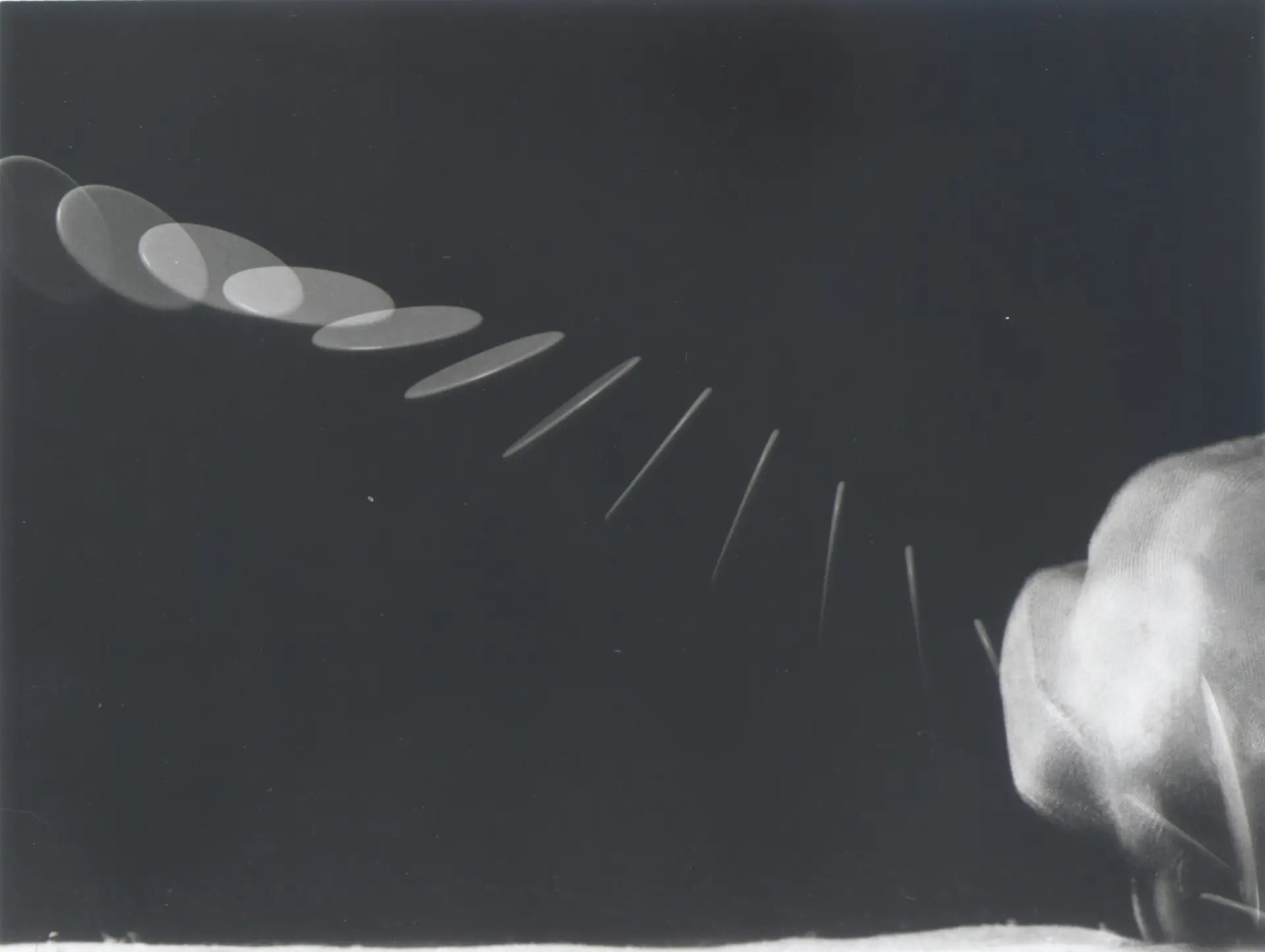
© 1983 R. W. TUCKER
BOONDOCK!
120 flashes per second
From WW42
by Geoffe Thorpe
(From Winking World 42, March 1983)
The next issue raised was the Megacrud and the large number of winks that Southampton were breaking. A major problem with these shots is judging their legality. It was suggested that the American rule prohibiting playing such shots from above a certain height (no one was sure what) {one inch} was worthy of consideration.
I have been playing winks for a little over (?) years at Sotwink and during this time I have played two distinct types of game there.
The usual style at our meetings is the so-called ‘casual game’ (as opposed to the serious game). In the casual type of play the boundaries of accepted behaviour are relaxed to allow humorous, although not entirely legal, incidents to occur, the most famous being the ‘kick-the-table’ shot (slightly illegal megacrud). Additional off-table ploys include the casual remark (“there’s room in there to sub a bus”), and a request for a shot judge for the squidge off.
Ever since I started playing winks ten years ago the question of taking an English team to America has been discussed but unfortunately no team has yet gone. … It has been suggested to me that the only way to find if this is possible is to set a date, 1985. … Only when we know who can go can ETwA decide if it is an England team or just a private English tour. It won’t matter much to me; I just want to go there.
Two Hundred Game Players
| Tour | G | Winker | W | L | T | Points | PPG | W-L % | 1st Tournament | Latest Tournament |
|---|---|---|---|---|---|---|---|---|---|---|
| 80 | 587 | Sunshine | 374 | 207 | 6 | 2428 5/6 | 4.14 | .642 | 2/67 Triangular | 2/83 Imag Team |
| 64 | 579 | Severin Drix | 390 | 181 | 8 | 2542 1/2 | 4.39 | .680 | 2/67 Triangular | 4/83 Ith Reun |
| 61 | 559 | Bob Henninge | 348 | 208 | 3 | 2337 2/3 | 4.18 | .625 | 2/67 Triangular | 2/83 Imag Team |
| 67 | 546 | Dave Lockwood | 379 | 165 | 2 | 2406 2/3 | 4.41 | .696 | 12/70 Easterns | 2/83 Imag Team |
| 65 | 540 | Ferd | 339 | 194 | 7 | 2271 1/2 | 4.21 | .634 | 2/67 Triangular | 2/82 Cont |
| 61 | 507 | Larry Kahn | 368 | 134 | 5 | 2329 1/2 | 4.59 | .731 | 10/71 HOTT | 4/83 Ith Reun |
| 60 | 462 | Bill Renke | 318 | 142 | 2 | 2071 | 4.48 | .690 | 2/70 Cont B | 12/82 Bos Op Pr |
| 60 | 442 | Moishe | 197 | 241 | 4 | 1456 | 3.29 | .450 | 12/68 Cont | 2/83 Imag Team |
| 56 | 429 | Joe Sachs | 251 | 174 | 4 | 1701 5/6 | 3.97 | .590 | 10/73 HOTT | 2/83 Imag Team |
| 54 | 400 | Rick Tucker | 204 | 190 | 6 | 1388 5/6 | 3.47 | .518 | 10/72 HOTT | 2/83 Imag Team |
| 36 | 329 | Bill Gammerdinger | 196 | 132 | 1 | 1321 1/2 | 4.02 | .597 | 12/70 Easterns | 2/81 Cont |
| 42 | 327 | Fred Shapiro | 153 | 172 | 2 | 1081 | 3.31 | .471 | 12/70 Easterns | 2/83 Imag Team |
| 43 | 322 | Charles Frankston | 156 | 164 | 2 | 1088 1/2 | 3.38 | .488 | 10/72 HOTT | 2/83 Cont |
| 39 | 317 | Mary Kirman | 155 | 157 | 5 | 1106 1/3 | 3.49 | .497 | 4/71 Br of Tree | 2/83 Imag Team |
| 41 | 308 | Don Fox | 155 | 150 | 3 | 1119 5/6 | 3.64 | .508 | 10/71 HOTT | 2/83 Cont |
| 33 | 295 | TDI | 172 | 118 | 5 | 1163 1/2 | 3.94 | .592 | 4/72 BIT | 2/82 Cont |
| 34 | 250 | Arye Gittelman | 145 | 104 | 1 | 966 5/6 | 3.87 | .582 | 5/77 Pairs | 2/83 Imag Team |
| 29 | 247 | Dave Barbano | 144 | 102 | 1 | 925 1/3 | 3.75 | .585 | 2/70 Cont | 2/80 Cont |
| 43 | 246 | L | 111 | 130 | 5 | 810 2/3 | 3.30 | .461 | 12/68 Cont | 2/83 Imag Team |
| 28 | 236 | Jim Marlin | 129 | 105 | 2 | 907 1/6 | 3.84 | .551 | 2/70 Cont | 5/80 Singles |
| 29 | 233 | Craig Schweinhart | 137 | 94 | 2 | 914 1/3 | 3.92 | .592 | 12/70 Easterns | 2/79 Cont |
| 32 | 227 | Nan Brady | 119 | 106 | 2 | 824 1/3 | 3.63 | .529 | 12/72 Easterns | 2/83 Cont |
| 29 | 223 | Ross Callon | 167 | 55 | 1 | 1030 5/6 | 4.62 | .751 | 12/71 Easterns | 2/83 Imag Team |
| 28 | 217 | Scott Hirsh | 136 | 77 | 4 | 886 1/2 | 4.09 | .636 | 12/71 Easterns | 3/81 SFET |
| 33 | 215 | Dean Solomon | 97 | 118 | 0 | 731 1/6 | 3.40 | .451 | 2/70 Cont | 2/83 Imag Team |

Career Pairs Statistics
| Games | Partner | Partner | Wins | Losses | Ties | Points | PPG | Win % |
|---|---|---|---|---|---|---|---|---|
| 113 | Dave Lockwood | Larry Kahn | 81 | 31 | 1 | 512 | 4.53 | .721 |
| 93 | Bob Henninge | Nan Brady | 57 | 36 | 0 | 366 5/6 | 3.94 | .613 |
| 90 | Dave Lockwood | Joe Sachs | 60 | 30 | 0 | 379 1/2 | 4.22 | .667 |
| 89 | Larry Kahn | Rick Tucker | 67 | 22 | 0 | 398 1/2 | 4.48 | .753 |
| 88 | Bob Henninge | Ferd | 68 | 20 | 0 | 434 2/3 | 4.939 | .773 |
| 88 | Bill Renke | Bill Gammerdinger | 60 | 28 | 0 | 403 | 4.58 | .682 |
| 83 | Dave Barbano | Phyllis Barbano | 46 | 36 | 1 | 291 | 3.51 | .560 |
| 82 | John Reppy | Ken Moraff | 48 | 33 | 1 | 307 1/2 | 3.75 | .591 |
| 81 | Ferd | Don Fox | 48 | 33 | 0 | 344 1/3 | 4.25 | .593 |
| 72 | Tim Schiller | Franz Christ | 56 | 15 | 1 | 347 2/3 | 4.83 | .785 |
| 71 | Ferd | Betsy Smith | 39 | 31 | 1 | 274 1/2 | 3.87 | .556 |
| 66 | * | Bill Gammerdinger | 44 | 22 | 0 | 280 | 4.24 | .667 |
| 64 | * | Mary Kirman | 41 | 23 | 0 | 261 | 4.08 | .641 |
| 64 | Severin Drix | Larry Kahn | 52 | 10 | 2 | 329 1/3 | 5.15 | .828 |
| 63 | Bill Gammerdinger | Dean Solomon | 33 | 30 | 0 | 228 5/6 | 3.63 | .524 |
| 56 | Severin Drix | Dave Pinckney | 44 | 10 | 2 | 276 5/6 | 4.943 | .804 |
| 55 | Charles Frankston | Martin Ross | 33 | 21 | 1 | 214 | 3.89 | .609 |
| 49 | Rosie Wain | Andy Tomaszewski | 31 | 18 | 0 | 224 | 4.57 | .633 |
| 49 | Bill Renke | Jim Marlin | 29 | 19 | 1 | 196 2/3 | 4.01 | .602 |
| 45 | Bill Renke | Ross Callon | 37 | 8 | 0 | 239 1/2 | 5.32 | .822 |
| 45 | Bill Renke | Dave York | 38 | 7 | 0 | 223 1/2 | 4.97 | .844 |
| 45 | * | Jeff Wieselthier | 38 | 7 | 0 | 228 | 5.07 | .844 |
World Singles 16 At a Glance
| 1 | 2 | 3 | 4 | 5 | 6 | Final | |
|---|---|---|---|---|---|---|---|
| Larry Kahn | 6 | 1½ | 4½ | 1 | 6 | 6 | 25 |
| Jon Mapley | 1 | 5½ | 2½ | 6 | 1 | 1 | 17 |
NATwA Secretary-General
Larry Kahn
18802 Nathan’s Place
Gaithersburg, Maryland 20879 USA
HOME: (301) 258-1129
WORK: (301) 840-3315
Newswink Editor
Rick Tucker
2701 Woodedge Road
Silver Spring, Maryland 20906 USA
HOME: (301) 933-3840
WORK: (703) 827-6699
Oxford University Press
THE OXFORD DICTIONARIES
37a St. Giles’, Oxford OX1 3LD
Telephone 0865 56767 Cables CLARENDON PRESS OXFORD Telex 838330
Chief Editor R. W. BURCHFIELD, C.B.E., Hon. D.Litt. (Liverpool)
Dear Mr. Shapiro,
I wonder if you would be kind enough to send me a photocopy of the following quotation from Guy Consterdine’s On the Mat (English Tiddlywinks Assoc., 1967):
If both members of the team have all their winks either cupped or covered then it shall be said that they are squapt (Minutes of Cambridge Univ. Tiddlywinks Club, 1956, Mar. 12).
I should like to use this example in the entry for squop in the final volume of the Supplement to the Oxford English Dictionary, but have been unable to locate a copy of Consterdine’s book or pamphlet. As the source is rare, it would be helpful if we could keep an exact record in our files.
Thank you very much.
Yours sincerely,
[signed] J.A. Simpson
J.A. Simpson
Senior Editor (General)
Mr. F. Shapiro,
43-19 56th Street,
Woodside, New York 11377,
USA.
Minutes of the 1982 NATwA Congress at MIT Student Center, West Lounge
13 February 1982.
Congress called to order at 18:16.
Larry calles [= calls] for nominations for Secretary General. He is promptly nominated and elected.
Bill-R on finances: doing well until this year due to equpment sales, but NW’s and Songbooks have been drawing down funds. $91.94 in NATwA treasury prior to today. Been earning 14%. Probably collect $100 in dues at this Continentals, but will probably have $100 in expenses. Still owe about $300 to equipment fund bond holders from 1978.
Equipment: no mats for sale at MIT, few winks. MIT has some bad winks, lots of cups; Dave-L has about 20 pots. Joe brought 5 sets to Larry.
Dave-L moves to charge any member who takes more than one NW or songbook $1 each. Agreed.
Squidgers still very shot [= short] supply. Bill-R seems to think we should have hat [= at] least 20 sets worth of winks if we distribute it right. Move to up dues to $5 for veterans next year – Dave-L. Passes unanimously.
Dave-L moves to charge $1 per NAC tournament. Idea is frowned on.
Bill-R and Larry each pledge to forward $100 for mats from England.
Tournaments: Larry: Pairs probably 17-18 April in Ithaca; 0 entrants likely from Boston. Some discussion of whether people (L & Moishe) aren’t coming because the tournaments are too tough. As an alternate arrangement Joe proposes winking morning, touring afternnons [= afternoons] and play in the evening.
Singles: likely Memorial day weekend, 29-30 May, MIT. Dave-L: is there a format for the singles that would attract people to play in it. Larry suggests playing with pairs.
* & Joe will most likely host something in Spring in Phila., maybe summer. Also maybe summer in Ohio.
18:49 Rules: Undersize tables. Larry moves that judgement [= judgment] of winks off table be purely based on whether wink is on mat or not. Unsupported winks would be moved onto supported mat (via shortest distance, and a bigs wink [= big wink’s] length in). Arye moves that it be the choice of the person whose wink it is, but any wink on mat should be shot from where it is. Vote: 5 for Arye, 9 against; 9 for Larry, 4 opposed. Etwa rule which says that the wink is off is voted down 0-∞.
Jabshots [= Jab shots]: 1/2 inch rules, change it to 1 inch? Dave-L willing to go to 2″. In favor of increasing distance: 8, opposed: 10, motion defeated.
Replacing winks shot over baselines. If there are winks behind base line the wink should be replaced onto the 3’ end of the mat. For 11, Against: 3.
Dave-L on giving titles to non-national finishers: proposes that the title shall go to the winner. The top finisher of a particular nation has the right to challenge for the world title. This means that Pam Knowles is the 1980 NA singles champion if the English reciprocate.
Is the world pairs a challenge cup? Yes, 4-2. Motion that if the winner of a NA pairs is the partner of the defending world championship pair, then the winning defender may choose who to defend with and the other defender may choose a partner to challenge with.
Joe gives away some memorabilia; original Allegheney [= Allegheny] presents and missing winks etc.
19:18 Move to adopt English clock rule. (Opponents have option re stopping clock). Some people seem to feel that it is a benefit to the pair that is ahead. Bill-R thinks games take long due to time taken in rounds, not clock stopping. * point was that it makes the clock a tactical weapon. * proposes a rule of 3 timeouts, otherwise 30 second timeout to warn, followed by 15 seconds then shoot or loose turn. TDI thinks it should be tried in tournament first. Bill-R thinks it is too much bookkeeping.
*: try timeout rule in next low key tournament. Ross: 1 or 2 timeouts added to English rules. 10 for *’s proposal, 6 against.
Vote to keep old American timeout rule: 9 in favor, 8 opposed.
It is also unanimously voted that the clock need not be stopped if both sides do not wish it to be.
19:35 Regional coordinators: Sue & L in East. Ken-M in West. Bob in Ohio.
Dave speaks of poor tournament participation. Wants city centers to hold monthly get-togethers. Publicized tournaments in someone’s house. Wants NATwA to pay for publicity. Also don’t keep stats on non-NAC tournaments. dave’s motion dies.
19:44 Adjourned to fun at Arye’s. Starting time 9:30 AM tomorrow.
1983 NATwA Congress • 19 February 1983
Convened 18:46 in the MIT Student Center in front of Mezzanine lounge.
Congress opens following the Lockwood’s baby shower.
Larry is reaffirmed as sec-gen.
Equipment: We’ve got Mats – Larry has about 10 at his house. Are there any more? Mats cost about $10 each. Winks situation is poor. The pot mold is still at the plastic molder in Brooklyn. Fred is charged with taking possesion [= possession] of the mold.
Dave-L reports that ETwA has voted that opponents may refuse to play with “adultered” (i.e. flattened) winks. It is voted that NATwA players may refuse to play with Munster.
Dave-L proposes that votes at Congress be proportional to number of games played in last 2 year’s continentals — ignored.
Singles – Memorial Day Weekend in Boston.
Pairs – Serious or not? Location – Ithaca? Date? Before or after Singles? Also talk of some Spring tournament, pairs or not. Something is discussed for 16 April weekend in Washington, probably Larry’s place.
Discussion of knockout format for continentals. Give the less interested people a chance to see more of Boston after they get knocked out. Bob says his people would rather play everyone round-robin.
19:06 What’s going on tomorrow? Show up at 10:00.
Who’s the treasurer? Larry is.
19:10 Adjournment.